A House, A Legacy, A Collection
It is amazing to find that despite the checkered history
of the Frederic Remington Art Museum collection, the museum is still
a place where one can feel the artist's presence. The number one question
asked by visitors is, "Did Remington live here?" The answer
is no, but this is the place to know him best. The house that has been
the center of the museum since its inception in 1923 is a place Remington
surely visited on his many trips to Ogdensburg. In 1900 it was remodeled
from its original 1810 appearance by Remington's friend George Hall,
with rich quarter-sawn oak interiors where Remington would have felt
quite at home. It was as Hall's guest that Eva Caten Remington and her
sister, Emma Caten, lived here from 1915 through 1918. The lobby still
takes visitors' breath away.
The depth and breadth of the museum's Remington holdings
is unmatched. The great majority of items came directly from Eva Remington's
1918 estate. They include annotated scrapbooks, endless pages of notes,
photographs - even the cigars that were in his pocket before he died.
Much of this Eva Remington certainly retained for posterity. The artist's
library is displayed on the second floor of the historic house, near
the Remingtons' tall, surprisingly narrow bed and other furniture. The
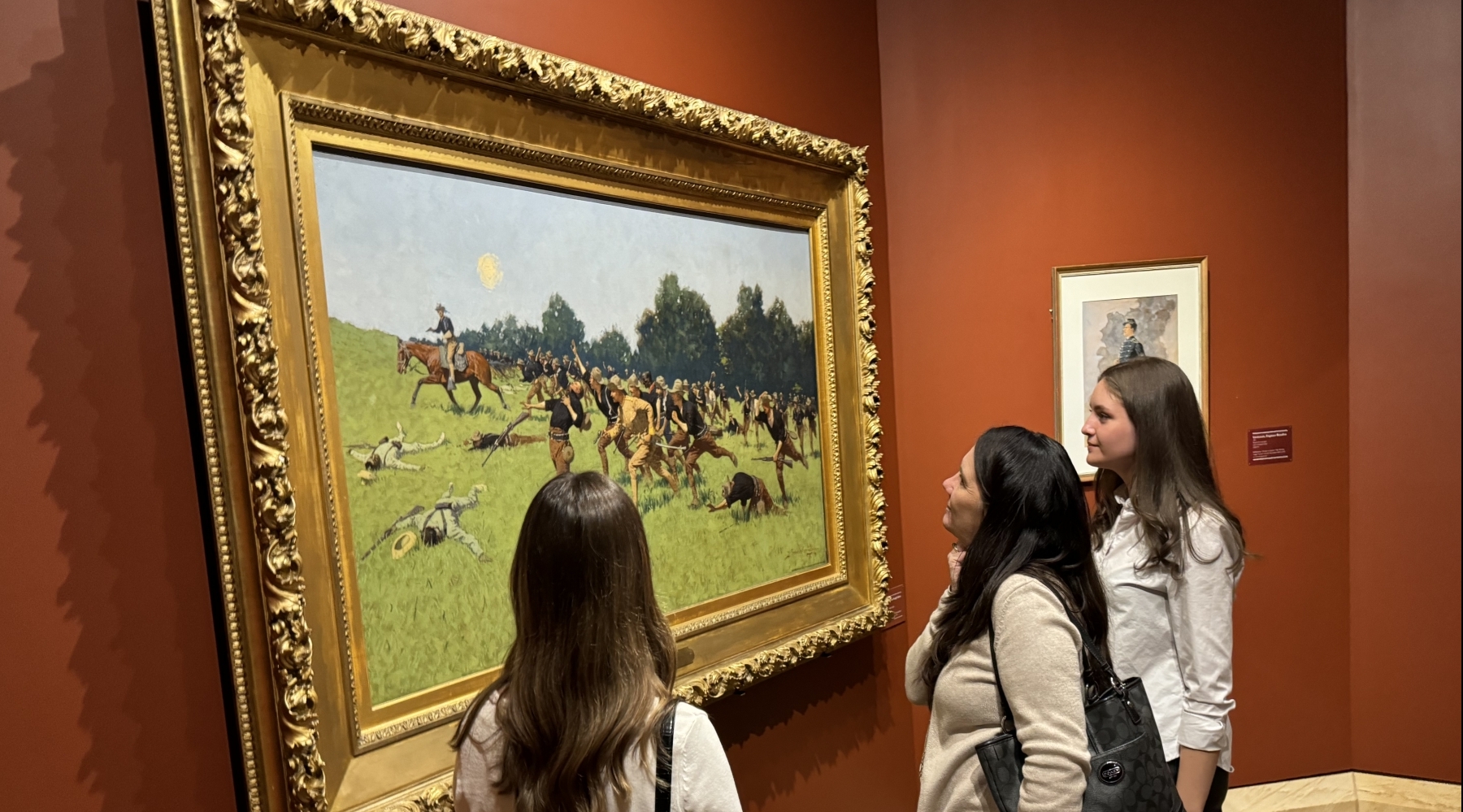
visitor is treated to an exhibit of fine art from the Remington home
in the room that was once George Hall's dining room. On the way to the
art galleries, one can see Remington's easel, paintbrushes and sculpting
stand, and also such diverse items as his hockey stick and his elk's
tooth cufflinks.
So, though the artist never lived here, the scope of
his possessions here, including his working tools; thousands of notes
and sketches; the fact that his widow lived here in the house of his
friend; and the contemporaneous aesthetic of the place compound to make
one feel that this is where Remington is found. The collection of Remington's
paintings, drawings and bronzes represented in this catalog is, of course,
the most important thing we have, but it's the combination of all the
disparate elements that lets you imagine Frederic Remington here, perhaps
smoking cigars and drinking whiskey into the night with any member of
his elite circle of friends.
To sit in the wood paneled lobby on any quiet day in
the light of Remington's Tiffany turtle-back chandelier, one can feel
part of a continuum from the earliest days of the museum, starting in
1923 when the museum (until 1981 the Remington Art Memorial) was staffed
by only one woman, the curator, Sarah Raymond, and after her by curator
Ursula Hornbrook. One might expect that the museum and its collection,
so far off the beaten track geographically, have slumbered unmolested
until the late 20th Century. The history of the collection is far more
complex and precarious.
The Remington Art Memorial
Eva Remington (1859-1918), Frederic's widow, left most of her collection
of Remington's art, notes, correspondence, working tools and studio
props to the people of Ogdensburg in care of the Board of Trustees of
the Ogdensburg Public Library. The Remington Art Memorial opened in
July 19th, 1923, in the historic Parish Mansion. This core collection
still comprises the majority of paintings and bronzes owned and displayed
by the museum. The archival elements of the gift -- from the artist's
diaries, to hundreds of sketches and photographs, ledgers and checkbooks
-- provide information meaningful to researchers looking into any aspect
of Remington's work or personality.
The oil paintings Eva Remington left are largely from
the last few years of the artist's (1861-1909) life. We know from various
records that she sold a good many paintings during the nine years she
lived as a widow. An ongoing question for us is, "why did these
particular paintings remain to form the museum's initial collection?"
Were they her favorites, or the least favorite of the art buyers? The
contents of Mrs. Remington's diaries, made available through the generous
1996 gift of Mr. William Deuval, raise quite a few questions about the
composition of our holdings. For instance, on Friday, June 27th, 1913,
she writes, "In the P.M. I washed Frederic's paintings and varnished
them and made a great improvement." Museums and private collectors
are now working to remove such old yellow varnish from Remington's paintings.
On Thursday, March 18th, 1915, she records, "Went over things in
Frederic's desk & burned a lot of photos, etc." We may never
know what she deleted from the historic record, or, just as compelling
- why she did it. Clearly our holdings were not preserved in a time
capsule before they came to us, and sometimes not after they were here.
It is hard to get a good view of the museum's early history,
since no files exist pertaining to daily operations until the late 1960's.
The archives contain early correspondence between John C. Howard (Eva
Remington's executor) and the Library of Congress pertaining to copyright
renewals, as well as correspondence between first curator Sarah Raymond
and Ricardo Bertelli at Roman Bronze Works, where most of the bronzes
were cast. One must rely on the old minutes of the Ogdensburg Library
Board of Trustees and several scrapbooks of press clippings and notes.
Creation of formal records of the museum's holdings was not initiated
until 1966.
Early Patronage
The museum's first and most important patrons were Eva Caten Remington,
who founded the collection with her bequest in 1918; John C. Howard,
Remington's lifelong friend and the Estate of George Hall, Howard's
employer, which provided the building to house it. The first recorded
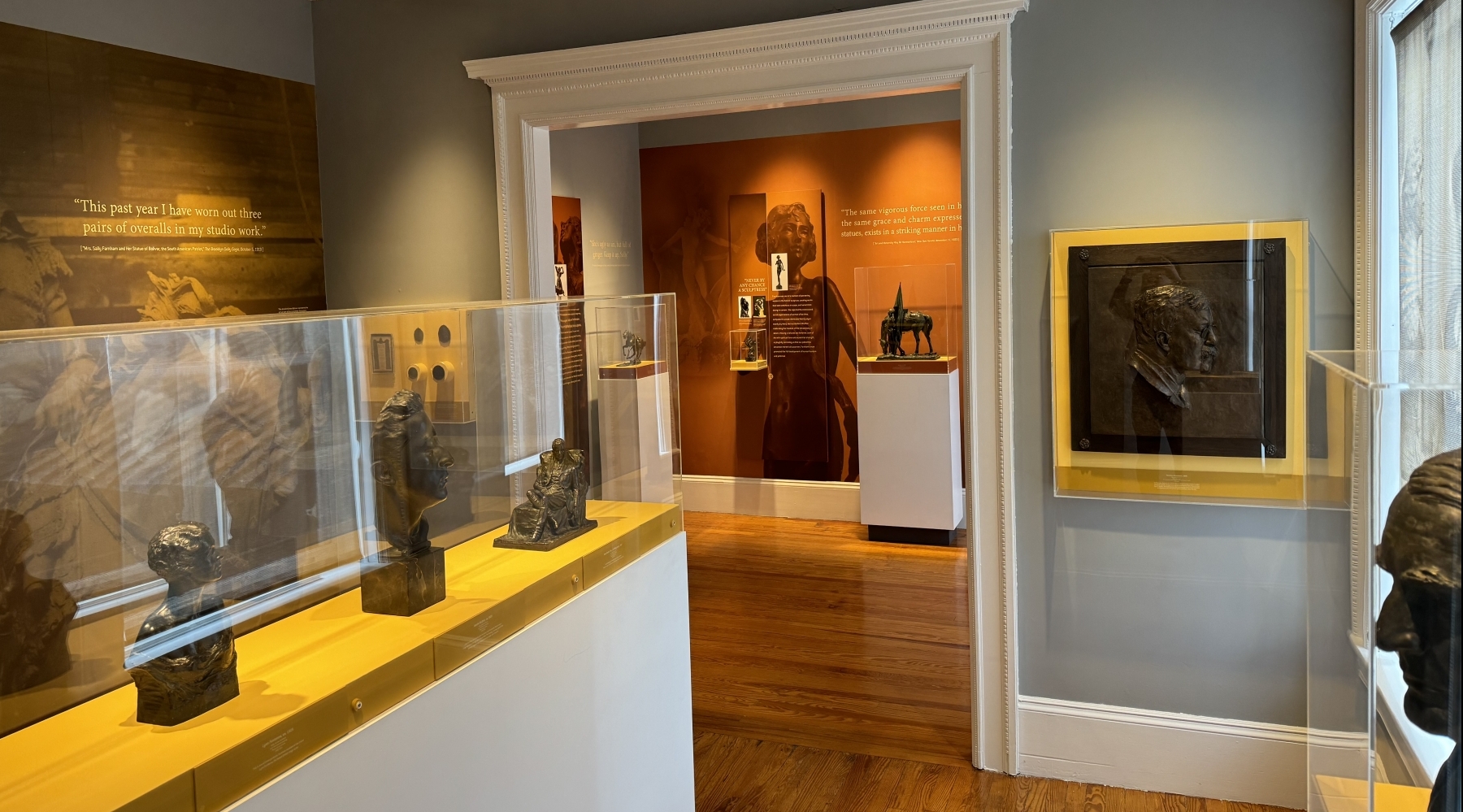
addition to the museum's holdings was a gift from Remington's friend,
fellow sculptor, Sally James Farnham of her busts of President Warren
Harding and Marshal Ferdinand Foch. Her bronze, Horse and Rider, was
already part of the Remingtons' own art collection. An Ogdensburg native,
Frederick T. Haskell, donated a diverse collection of minor European
and American paintings and bronzes with the wish that they be sold to
buy Remington art. The Haskell collection was displayed in one of the
museum's crowded rooms. The first purchases of Remington art were made
by selling art from the Haskell collection. Some examples are: The Gallic
Captive (purchased in 1947), The Last March (purchased in 1948), and
The Apaches Are Coming (purchased in 1950).
Frederick T. Haskell also gave the museum a set of Belter dining room
furniture and other household items from the family that built and occupied
the 1810 Parish Mansion until 1859, when George Parish returned permanently
to Europe he auctioned the household property. Parish was so prominent
in the region, as a landowner an employer, and the auction so memorable
that items auctioned still retain their history. Parish tables, chairs,
footstools and candlesticks are still coming to the museum as donations,
140 years later. The Parish House and the history of its original occupants
has become an unstated, secondary mission of the museum.
Questionable Patronage
In 1945 Dr. Harold McCracken, who can now be seen as an anti-hero of
the museum's collection, began a series of visits to Ogdensburg and
Canton to interview those who had known Frederic Remington and to study
the museum's art and archives in preparation for his book, Frederic
Remington: Artist of the Old West, which was published in 1947. McCracken
took the initiative to suggest purchases of Remington originals and
"Remingtoniana." He actually made the purchases himself, as
the museum's agent, using funds from sales of art from the Haskell Collection.
In the late 1940's and early 1950's, when McCracken was involved with
the museum, the president of the Board of Trustees of the Ogdensburg
Public Library and the memorial was Franklin Little, the editor of the
Ogdensburg newspaper, The Ogdensburg Journal. Little was an enthusiastic
adherent to McCracken's advice and used his paper to celebrate the museum
and rally public support for its activities.
One clipping states that in 1946 Harold McCracken and
curator Ursula Hornbrook found a cache of undiscovered Frederic Remington
oil studies in an attic room at the museum. This discovery became the
impetus for the 1954 sale of 452 numbered items including Native American,
Western and military artifacts and 110 oil paintings and studies that
comprised most of Frederic Remington's "Indian" or "Studio"
collection. Upon the advice of Harold McCracken, the Board of Trustees
of the Ogdensburg Public Library sold this collection to Knoedler Galleries
in New York for $10,000.00 in cash and $10,000.00 worth of painting
conservation and re-framing, performed by Knoedler. The Museum used
the money to replace the coal-burning furnace and paint the inside and
outside of the building. This work was planned and overseen by a Mr.
Davison, of Knoedler Galleries. The press focused not on the sale of
this collection, but on the accompanying 1955 exhibition at Knoedler,
which traveled to a second venue at the Ft. Worth Art Center. The exhibition
included many of the museum's bronzes and oil paintings by Remington,
loaned by the Library Board. When the museum's art returned and the
refurbishments were done, the memorial re-opened with a ribbon-cutting
ceremony on June 31, 1955. It is our great consolation that the studio
collection was purchased from Knoedler by the Coe family, who then donated
it to the Buffalo Bill Historical Center in Cody, Wyoming as the founding
collection of the Whitney Gallery of Western Art. Harold McCracken was
its first director.
Today it is recognized as unethical by the museum community
to sell a museum's collection to benefit its physical plant.
Gains and Losses
Emma Caten, Eva Remington's sister, remained in Ogdensburg after Eva's
death and lived in Ogdensburg until her death in 1957. Miss Caten maintained
a continual presence at the museum and served on the Ogdensburg Library
Board. As Frederic Remington's sister-in-law, who out lived him for
nearly four decades, she deserves ample credit for her work to keep
Remington's legacy alive. She certainly believed in Harold McCracken
as Remington's long-sought biographer and proponent. There is ample
evidence that she gave him many gifts of Remington art and property
left to her by her sister. Miss Caten owned a good deal of Frederic
Remington sketches and paintings, art from the Remington home, Remington
household furniture and other property. Many of these items rejoined
the museum's collection upon Miss Caten's death. She gave away an unknown
number of Remington items to friends and family. Three separate donors
recently gave the museum Remington's paperweight, ivory folding bone
and six of Eva Remington's diaries, all of which had belonged to Miss
Caten. There are tales of boys receiving original Remington art in payment
for shoveling Miss Caten's driveway. It is easy now to lament the losses
to the collection from this diverted route from Eva, to Emma, to others.
At an earlier time that we have not been able to determine,
an unknown quantity of Remington sketches, torn from sketchbooks, were
sold at the front desk of the memorial for 75 cents and $1.00. We know
this because many of our loose sketches still have price marks in the
corners. One time, in the early 1990's, two gentlemen visited the museum
from Canton, Ohio. They brought with them dozens of these sketches,
which had come to them through a relative who had lived in Ogdensburg
long ago. The museum can only hope to see the sketches again.
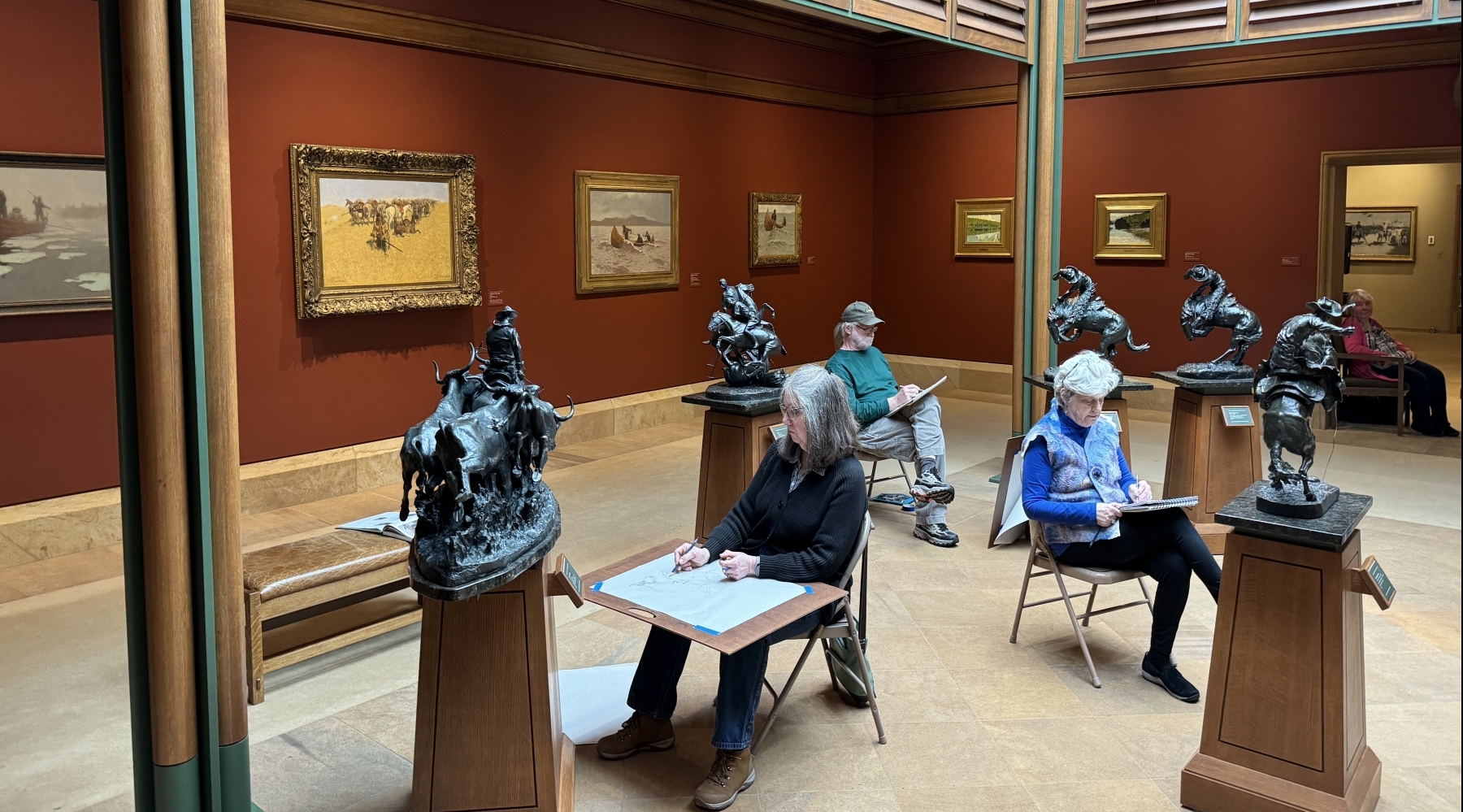
The Remington bronzes in the museum's collection came
largely from Eva Remington's estate, with the notable exceptions of
the 1985 gift of Cheyenne #12 from Robert and Lorraine Hollins and the
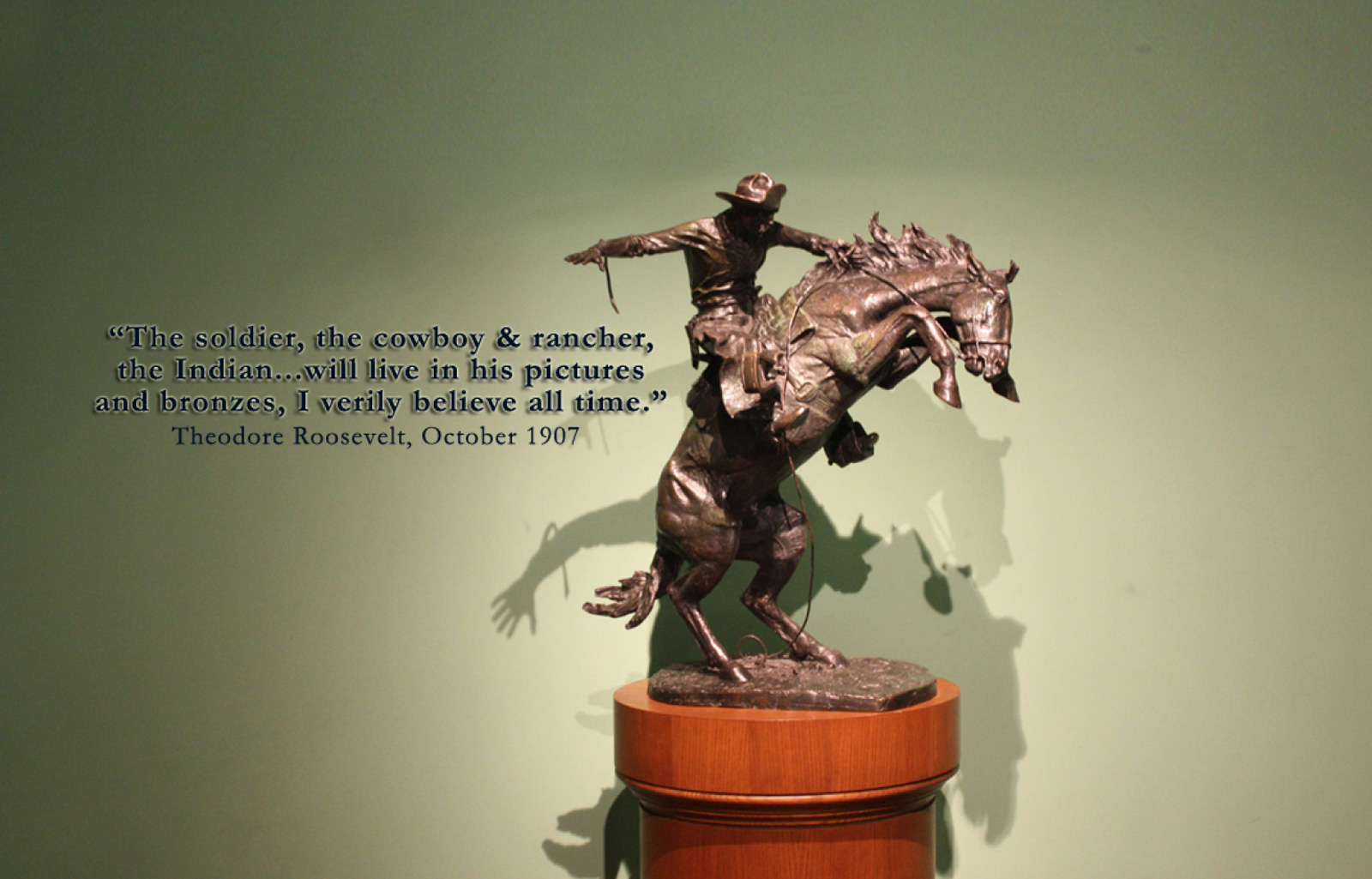
1991 purchase of the Henry-Bonnard cast #23 of the Broncho Buster. The
bronzes from Mrs. Remington's estate range from the very good casts
of The Sergeant and Polo to some of the very last legitimate bronzes
made at the request of her will.
The Maturing Museum
In 1973 Remington Art Memorial staff re-created Frederic Remington's
Ridgefield, Connecticut studio in the west room of the ground floor.
They bought and borrowed hundreds of artifacts to approximate Remington's
own that had been sold in 1954. The Museum has since found a better
solution, in displaying only the artifacts that belonged to Frederic
Remington, making no attempt to "recreate" his studio. Museum
staff are pleased to have the long-term loan of six of Frederic Remington's
guns from the Buffalo Bill Historical Center; part of the 1954 sale.
The museum is fortunate to have a loan exchange program with the Buffalo
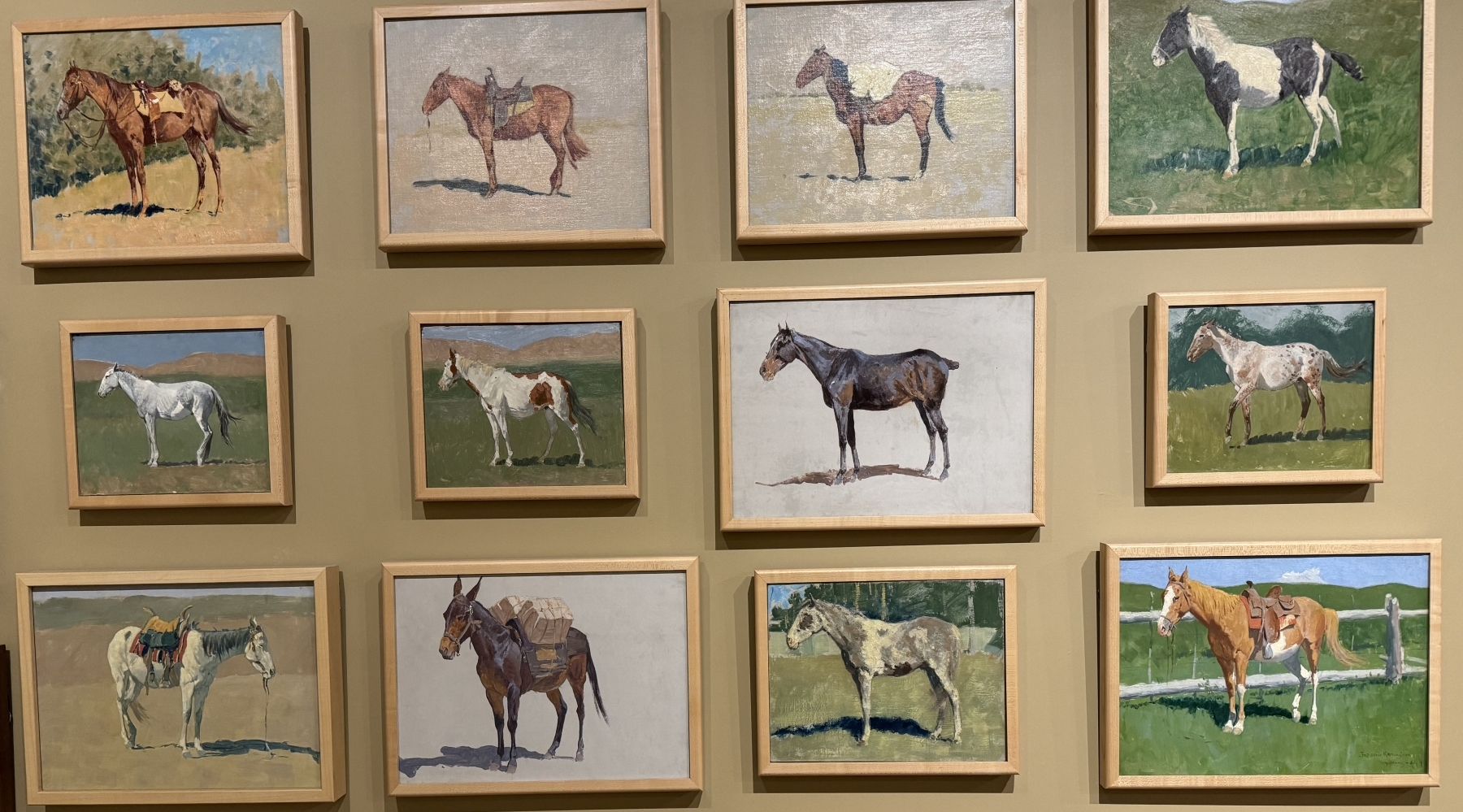
Bill Historical Center, in which the museum borrows and displays fifteen
North Country based oil studies -- also part of the 1954 sale to Knoedler
& Co. -- in exchange for one of our major Western Remington oil
paintings.
Contemporary Benefactors
The Newell family, whose notable ancestor, Allan Albert Newell, was
a boyhood friend of Frederic Remington's in Ogdensburg, has provided
the most meaningful patronage since Eva Remington's original gift. In
the last quarter-century the Newells have provided major support for
two capital expansion projects and a steady stream of support for the
museum's priority needs, including, at times, salaries, Remington acquisitions,
art and furniture conservation - even the printing of this catalog.
In 1976 William Allan Newell funded an addition to the
historic Parish Mansion to provide two modern galleries, an art storage
vault and a small archives room. This Newell Wing provided a separate,
fire-safe structure for the storage and display of Remington's art.
The Parish Mansion was then developed as a historic house, emphasizing
its early history (1810-1859) with the Parish family and the three years
(1915-1918) when it was occupied by Eva Remington.
The museum expanded again in 1997, adding gallery space
and collection workspace in an improved Newell Wing. The wing physically
links the Parish Mansion with the historic 311 Washington Street house
that provides museum offices and public reception rooms. The improvements
go far beyond increasing gallery space and collections work areas. The
architect and exhibit designer made sure to carry the 19th Century oak
motifs and period colors -- of which Frederic Remington would have approved--
throughout the gallery spaces, providing a visual context for the art
and providing visual continuity between the old and new parts of the
museum.
Collecting Today
Since 1985, the museum has pursued an acquisitions program, collecting
art and property connected to Frederic Remington or the Parish family.
Due to the ever-escalating values of Remington art, acquisitions are
now almost entirely achieved through the gifts of generous donors. Donations
over recent decades have greatly enhanced the museum's already strong
collection of illustrations, both works on paper and black and white
oil paintings. The museum does purchase Remington letters, sketches
and other archival items using funds from its modest acquisitions account.
The museum is currently poised to begin an endowment campaign and has
a growing foundation. This funding will further the museum's endeavors
to create effective exhibits, maintain and expand a strong collection,
improve research capabilities and develop education programming that
encourages understanding of Remington and perpetuates a sense of the
artist's presence.
Laura A. Foster
Curator
October 6, 2000
The mission of the Frederic Remington Art Museum is to
collect, exhibit, preserve, and interpret the art and archives of Frederic
Remington. The Museum fosters an appreciation for and an understanding
of the artist by educating its audience in the visual arts and by providing
a context for Remington's life in Northern New York.
The museum is accredited by the American Association
of Museums.